
Series: Cost of Living Crisis (Part 3 of 4)
Recent policy update worth flagging (early 2026)
Childcare is also back in the policy crosshairs, which reinforces the article’s thesis that the market does not self-correct without durable public rules and funding.
- CCDF rule rollback proposal (comment deadline early Feb 2026): HHS proposed rescinding parts of the 2024 Child Care and Development Fund rule, including provisions that would have limited co-pays to 7% of income and encouraged more stable provider payments.https://www.federalregister.gov/documents/2026/01/05/2025-24272/restoring-flexibility-in-the-child-care-and-development-fund-ccdf
- HHS action on payment oversight (Jan 2026): HHS announced it would rescind “pay before attendance” provisions, framing the change as tightening oversight and reducing fraud risk.https://www.hhs.gov/press-room/hhs-close-biden-era-loophole-states-pay-child-care-providers-without-counting-attendance.html
- FY26 funding package signed (Feb 2026): Advocacy groups report Congress passed and the president signed FY26 appropriations that include a modest CCDBG increase (reported as $8.831B, +$85M). Treat this as “stability, not a solution,” relative to the size of the shortage.https://info.childcareaware.org/blog/child-care-and-early-learning-protected-in-final-fy26-package
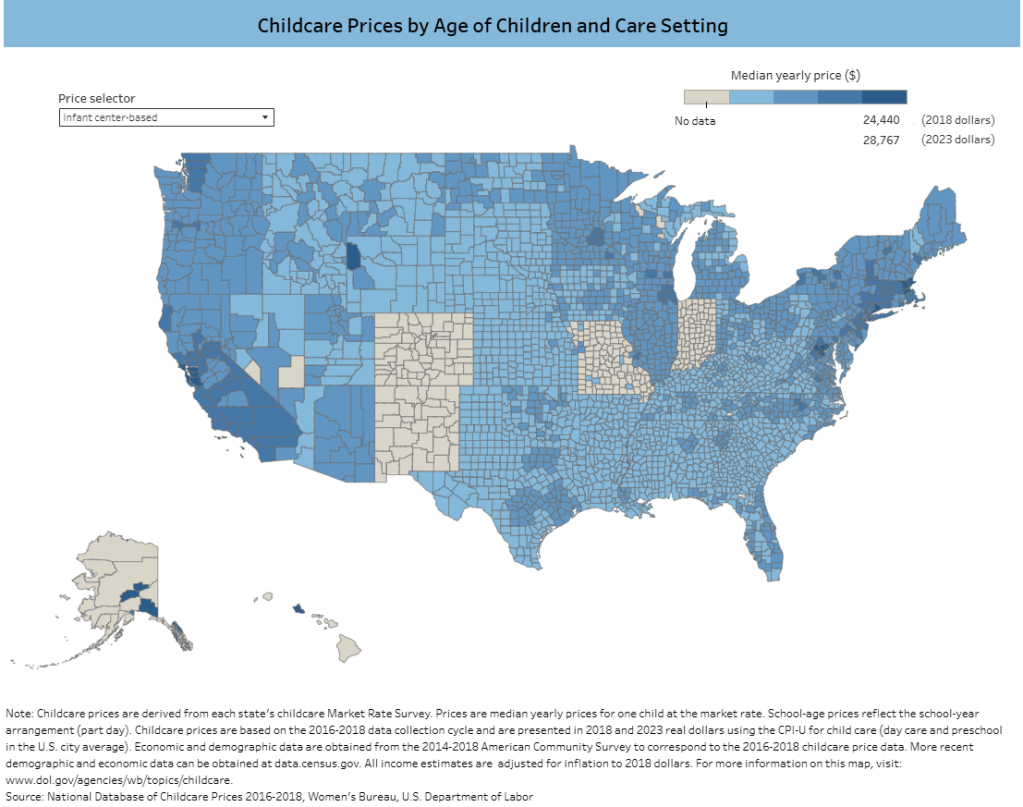
Source: U.S. Department of Labor, Women’s Bureau — National Database of Childcare Prices (2016–2018), with inflation-adjusted values.
- Child Care Aware of America (Price & Supply 2024): https://www.childcareaware.org/price-landscape24
- Women’s Bureau NDCP landing page: https://www.dol.gov/agencies/wb/topics/childcare/price-by-age-care-setting
Executive summary
Childcare has become one of the sharpest cost-of-living pressure points because it breaks the normal logic of a market.
- Parents are paying prices that feel absurd.
- Providers are still operating on thin margins.
- Caregivers are often paid wages that do not match the responsibility.
Thesis: Childcare is a market failure that hurts both sides at once. Stable solutions treat early care as infrastructure, not a luxury add-on.
I. Introduction: The impossible choice
In much of the United States, childcare now costs as much as a second rent payment, and in many places it rivals a year of public college tuition. That is not a punchline. It is a constraint on family formation, a tax on work, and a bottleneck on the labor force.
The decision many parents face is brutally arithmetic. If a second income is consumed by childcare, commuting, and taxes, working can feel like paying to be away from your child. Meanwhile, providers cannot simply cut prices, because the business is mostly labor, and safety ratios cap how many children one adult can supervise.
That is the core thesis here: the childcare market fails both sides. Parents cannot afford it, providers cannot sustainably supply it at high quality, and workers are underpaid. The only stable solutions treat childcare as infrastructure, not as a luxury consumer good.
II. The affordability crisis, by the numbers
American families face a childcare affordability crisis that rivals or exceeds the cost of college.
Childcare exceeds college tuition. In 38 states and Washington, D.C., the annual cost of full-time infant care in a center exceeds in-state public college tuition.[1] This increased from 33 states before the pandemic, suggesting the pressure is not easing.[1]
National average cost is rising fast. The national average price of childcare reached $13,128 annually in 2024, up from $11,582 in 2023, an increase that outpaced overall inflation.[2][3]
The income burden is the definition of “unaffordable.”
- For a married couple, that average cost is around 10% of median income.
- For single parents, childcare can consume 35% of median household income.[2]
- This blows past the U.S. Department of Health and Human Services guideline that childcare should cost no more than 7% of annual income.[2]
It varies by location, but nowhere is “cheap.” Average prices range from roughly $521 per month in Mississippi to $1,893 per month in Washington, D.C. for a four-year-old.[1]
For infants, the most expensive age group:
- Center-based infant care has been estimated from under $4,000 to over $31,000 annually depending on state and year (with inflation-adjusted figures higher).[4]
- In Hawaii, paying for infant childcare can represent 18% of a married couple’s median family income.[5]
Compared to housing, it can be worse. In many places, the annual cost for childcare for two children exceeds typical mortgage payments and rent.[3][6]
The paradox: families pay a lot, workers still earn little
While parents struggle with unaffordable costs, childcare workers often earn poverty wages.
- The median hourly wage for childcare workers was $14.60 in 2023 (bottom 5% of occupations), per the Chicago Fed’s summary of BLS OEWS data.[11]
- Childcare professionals would need to spend 44% to 100% of their own income, depending on state, to afford center-based care for two children.[3]
- In Illinois, a median childcare worker may need to spend about 50% of earnings to put their own child in infant care.[1]
If this sounds impossible, that is the point. It is structurally impossible under “normal” market rules.
III. The economic catch-22: why no one can win
A good way to understand childcare is to stop thinking of it as a normal service industry and start thinking of it as a tightly regulated labor-to-child ratio business.
Parents can’t afford it
When childcare takes 20% to 35% of take-home pay, the question stops being “what is the best program?” and becomes “can we keep working?”
For many households, especially those with two young children, the math can turn a second earner’s job into a break-even proposition. That is not just a short-term budget crunch. Career interruptions have compounding costs.
- Missed promotions and raises.
- Lower retirement contributions.
- Permanent “resume gaps” that can reduce lifetime earnings.
And because many benefits are tied to employment (health insurance, retirement matches), the “stay home” option can have hidden costs even when it looks rational in the short run.
Providers can’t make it work
Childcare supply gap (interactive)
- Map: https://childcaregap.org/
- Methodology/overview: https://www.ffyf.org/resources/2025/09/new-interactive-resource-reveals-staggering-data-on-the-child-care-gaps-across-the-united-states/
Chart image (rural vs urban supply): Private childcare establishments per 1,000 children (rural vs urban).

USDA ERS chart: Private childcare establishments per 1,000 children (rural vs urban)
Source: USDA Economic Research Service (Charts of Note), March 6, 2025.
Most childcare costs are labor. Often 70% to 80% of a center’s operating costs are staff compensation and benefits. That is not waste. It is the service.
Safety and quality standards cap scale. If infants require one caregiver for every few children, there is no productivity miracle that lets a center double output without doubling staff.
So when policymakers or commentators say “just increase supply,” the supply response is not like housing or manufacturing. You cannot rapidly scale without trained workers, licensing capacity, and facilities that meet strict requirements.
Workers are trapped in low pay, and quality suffers
If providers raise wages meaningfully without additional public funding, prices rise further and families leave. If providers hold prices down, wages stagnate and turnover rises.
High turnover is not just an HR problem. It is a quality problem. Young children do not thrive with constant churn, and consistent caregiving is part of what parents are paying for.
This is the market failure in one sentence:
Childcare is expensive because it is labor-intensive and regulated for safety, and it is underpaid because families cannot afford what “good” care would actually cost.
IV. Childcare is a labor force participation policy
BLS ATUS 2024 (print-friendly table): Average hours/day parents spent caring for and helping household children
| Group | Total caring time (hours/day) |
|---|---|
| Parents, child under 18 | 1.45 |
| Fathers, child under 18 | 1.09 |
| Mothers, child under 18 | 1.75 |
| Parents, child under 6 | 2.42 |
| Fathers, child under 6 | 1.80 |
| Mothers, child under 6 | 2.93 |
Source: U.S. Bureau of Labor Statistics, American Time Use Survey (ATUS), 2024 annual averages.
- Chart + full table: https://www.bls.gov/charts/american-time-use/activity-by-parent.htm
Childcare affordability has consequences beyond individual families. It constrains labor force participation, suppresses economic growth, and makes the economy less resilient.
The U.S. pattern in context
U.S. female labor force participation plateaued after decades of growth and has lagged parts of the OECD in recent decades.[7]
This is not just “culture.” It tracks whether policy makes work feasible when children are young.
International evidence: policy choices show up in employment
OECD research finds a clear relationship between childcare access and women’s labor market participation.[8]
Countries with extensive public childcare systems and subsidies tend to have higher maternal employment than countries where childcare is scarce and expensive.[9]
The pandemic made the hidden dependency visible
COVID-19 did not create the childcare problem, but it revealed the economy’s reliance on it. When childcare and schools shut down, millions of caregivers faced impossible choices, and many left work temporarily or permanently.
When childcare breaks, the labor market does not “adjust.” It shrinks.
V. Why the market fails (and why it keeps failing)
The childcare market fails for structural reasons, not because parents are bad shoppers or providers are incompetent.
A. Structural constraints
- Limited economies of scale: Staff-to-child ratios impose hard caps.
- Labor-intensive by design: You cannot “automate” attentive care without losing the thing you are buying.
- High fixed costs: Facilities, insurance, licensing, compliance, background checks.
- Thin margins even at high prices: Many providers operate close to the edge.
B. Information asymmetry
Parents cannot easily assess quality the way they can compare prices for most consumer services.
- Tour-day impressions can mislead.
- Credentials and glossy marketing can hide poor practices.
- Monitoring is hard, and switching is disruptive.
C. The quality-cost paradox
Quality is not a nice-to-have. It is the point.
- Higher quality requires better ratios, more training, and better pay.
- Better pay requires higher revenue.
- Higher revenue often means higher tuition.
If public financing does not bridge this gap, systems drift toward one of two unstable endpoints:
- “Affordable” care that struggles with staffing and quality.
- High-quality care that becomes a luxury good.
VI. International models that work
International comparisons are not about copying and pasting another country’s system. They are about identifying what successful systems have in common.
Scandinavia: universal access, high standards
Countries such as Sweden and Denmark treat childcare as a public good.
Common features:
- Broad access.
- Fees that are capped at modest levels.
- Strong quality and staffing standards.
- Public financing that makes decent wages compatible with affordability.
Outcomes commonly include high maternal employment and systems that are stable over time.[9]
France: integrate early care into public education
France’s école maternelle is a practical example of integrating early childhood education into the school system with near-universal participation for ages three to five.
The central lesson is not ideology. It is administration. When early care is treated as education infrastructure, it becomes easier to scale quality and access.
Germany: a transition case
Germany’s reforms and “Kita” expansion show that countries can move from limited supply to broad provision when the economic case becomes unavoidable.
Takeaway: cultural preferences matter, but they do not override affordability and labor market needs forever.
VII. U.S. policy options and tradeoffs
There is no silver bullet. The best packages combine affordability for families, stable revenue for providers, and compensation that supports a skilled workforce.
A. Universal pre-K (ages 3–5)
Universal pre-K is often the most politically feasible starting point.
- It is easy to understand.
- It can be administered through existing education systems.
- It can boost school readiness and reduce family costs.
Limitations:
- It does not solve infant and toddler care.
- It can strain the childcare market if it pulls staff away from younger-age classrooms without replacing capacity.
B. Subsidies that cap family costs (for working families)
A widely used policy benchmark is the 7% of income affordability standard.
A cap-based approach can be designed to:
- Reduce family out-of-pocket costs.
- Increase provider revenue stability.
- Expand access in “childcare deserts.”
Tradeoffs:
- Means-testing can add complexity and discourage take-up.
- Universal approaches cost more but are simpler and often more durable.
C. Tax credits
Tax credits (like the Child and Dependent Care Credit) are popular because they look like a “lighter touch.”
Pros:
- Familiar system.
- Lower administrative burden for some families.
Cons:
- Often help higher earners more.
- May arrive long after bills are due.
- Do not reliably increase supply or improve wages.
D. Direct public provision
Public provision through schools or community systems can expand supply and improve quality.
Pros:
- Quality control.
- Scale through existing public institutions.
Cons:
- High upfront capital needs.
- Slower rollout.
E. Provider supports and workforce investment
If policymakers want more supply, they have to make the workforce sustainable.
Tools include:
- Stabilization grants.
- Facility financing and startup support.
- Wage supplements tied to credentials and quality.
- Apprenticeships and career ladders.
F. Employer-based solutions (as a supplement, not a system)
Employer childcare can help in specific sectors, but it cannot serve as a nationwide solution.
It tends to benefit employees of larger firms and does little for rural areas, small businesses, and irregular schedules.
VIII. The economic ROI argument
Early childhood investment is one of the rare policy areas where many analysts agree the returns can be large.
Depending on program design and the population served, long-term studies have found substantial social returns, often summarized as multiple dollars back for every dollar invested, through:
- Higher lifetime earnings.
- Better education outcomes.
- Reduced later remediation and social costs.
The core economic logic is straightforward: childcare increases labor supply today, and early education improves human capital tomorrow.
IX. U.S. success stories: Oklahoma and Georgia
While the U.S. lags internationally, some states demonstrate that universal pre-K can work domestically.
Oklahoma’s universal pre-K
Oklahoma became an early adopter of universal pre-K for four-year-olds, and research on Tulsa’s program found strong early gains and evidence of longer-run benefits.[1][2]
Georgia’s pre-K program
Georgia’s universal pre-K, funded by the state lottery, has shown measurable kindergarten readiness gains.[3][4]
Key takeaway: universal pre-K is not limited to one region or political culture. It is doable.
X. Conclusion: treat childcare like infrastructure
Childcare is not just a family issue. It is economic capacity. When care is scarce or unaffordable, labor force participation drops, businesses lose workers, and households become more fragile.
The market cannot solve this on its own because the constraints are structural. Labor is the product. Safety ratios limit scale. Quality requires stable, trained workers.
Other wealthy countries fund childcare as a public good because it functions like one. The United States is the outlier.
A practical package looks like this:
- Universal pre-K as a near-term, politically feasible starting point.
- Cap family out-of-pocket costs at 7% of income, with subsidies that follow the child.
- Fund wage supports tied to quality standards so better care does not require poverty wages.
- Expand public provision through school systems and community providers to build supply where markets do not.
This is not radical. It is a decision to treat childcare like the economic infrastructure it is.
State-by-state fact sheets (St. Louis Fed): https://www.stlouisfed.org/community-development/child-care-economic-impact
Additional reading
- Housing Crisis: Supply, Demand, and Zoning Reform
- Student Debt: Causes, Consequences, and Solutions
- Why grocery prices feel higher even when inflation cools
- The difference between “jobs added” and “jobs people actually want”
- Prescription Drug Pricing: Market Dynamics and Policy Solutions
References
Child Care Aware of America. Child Care in America: 2024 Price & Supply.
HHS / ACF. Proposed rule: Restoring Flexibility in the Child Care and Development Fund (CCDF) (Jan 2026): https://www.federalregister.gov/documents/2026/01/05/2025-24272/restoring-flexibility-in-the-child-care-and-development-fund-ccdf
HHS press release (Jan 2026) on rescinding “pay before attendance” provisions: https://www.hhs.gov/press-room/hhs-close-biden-era-loophole-states-pay-child-care-providers-without-counting-attendance.html
Child Care Aware of America (Feb 2026) on FY26 funding package (CCDBG level reported): https://info.childcareaware.org/blog/child-care-and-early-learning-protected-in-final-fy26-package
First Five Years Fund. New Resource Reveals Notable Changes in Price and Supply of Child Care. May 2025.
Stateline (Pew). Costs of child care now outpace college tuition in 38 states, analysis finds. March 2025.
Economic Policy Institute. Updated resource calculates the cost of child care in every state.
PolicyMap. Childcare Costs Take a Growing Share of Family Income.
Visual Capitalist. Mapped: Infant Child-Care Costs by U.S. State.
U.S. Department of Labor Blog. NEW DATA: Childcare costs remain an almost prohibitive expense. November 2024.
Chicago Fed. Childcare Labor Market. 2024.
OECD. How does access to early childhood education services affect the participation of women in the labour market? Working Papers on Education, 2018.
OECD. Female Labour Force Participation: Past Trends and Main Determinants in OECD Countries.
RSI International. Childcare Subsidies and Female Labour Force Participation: A Policy Evaluation Perspective.
FCD-US. The Effects of Universal Pre-K in Oklahoma: Research Highlights and Policy Implications.
NASBE. Universal Pre-K in Tulsa: A Surprising Success.
University of Georgia, College of Public Health. Georgia’s pre-K program boosts kindergarten readiness.
Georgia Department of Early Care and Learning. Effects of Georgia’s Pre-K Program on Children’s School Readiness.
OECD Economic Surveys. Türkiye 2025: Removing the barriers to female labour market participation.
UNFPA China. Childcare Services Support Women’s Labour Force Participation and Economic Contributions. January 2026.
 The Rational Moderate