
When Congress blocks presidential initiatives, investigates administration actions, or refuses to confirm nominees, we call it either “necessary oversight” or “destructive gridlock” depending on our partisan preferences.
But there’s a real distinction. Oversight holds power accountable. Gridlock prevents necessary action. Both involve checking executive power, but one serves democracy while the other harms it.
Understanding the difference matters for evaluating whether Congress is functioning or failing.
A timely note: shutdowns and nominations made the distinction concrete (2025–2026)
- FY2026 began with a real funding gap. CRS describes a shutdown that started Oct 1, 2025 and ended Nov 12, 2025, and summarizes the economic effects.
- CRS (Jan 29, 2026): https://www.congress.gov/crs-product/R48832
- Nomination strategy has become procedural warfare. Reporting on late-2025 Senate efforts to move large nomination packages illustrates how confirmations can become a venue for delay and leverage, not quality control.
Oversight: checking executive power
Congressional oversight includes:
- Investigating potential wrongdoing
- Examining how laws are implemented
- Reviewing spending and program effectiveness
- Questioning officials under oath
- Demanding documents and testimony
This is fundamental to constitutional democracy. The executive branch controls vast bureaucratic power. Without legislative oversight, that power becomes unaccountable.
Effective oversight examples:
- Watergate hearings that exposed presidential criminality
- Church Committee investigating intelligence community abuses
- Financial crisis hearings revealing regulatory failures
- Pentagon Papers investigation of war conduct
These investigations served the public interest regardless of partisan outcomes. They revealed information voters needed to make informed judgments about government performance.
Gridlock: obstruction for partisan gain
Gridlock is different. It involves:
- Refusing to vote on qualified nominees without cause
- Blocking legislation with broad support for partisan advantage
- Opposing all presidential initiatives regardless of merit
- Holding government funding hostage for unrelated demands
Gridlock isn’t about accountability—it’s about denying the other party any achievements, regardless of policy consequences.
Recent examples:
- Senate Republicans refusing to vote on Merrick Garland’s Supreme Court nomination for nearly a year
- Government shutdowns over unrelated policy demands
- Blocking ambassadorial nominations, leaving key posts vacant for years
- Automatic filibusters of all significant legislation
These aren’t oversight—they’re sabotage. The goal isn’t better governance or accountability but making the president look ineffective, regardless of harm to national interests.
How to tell the difference
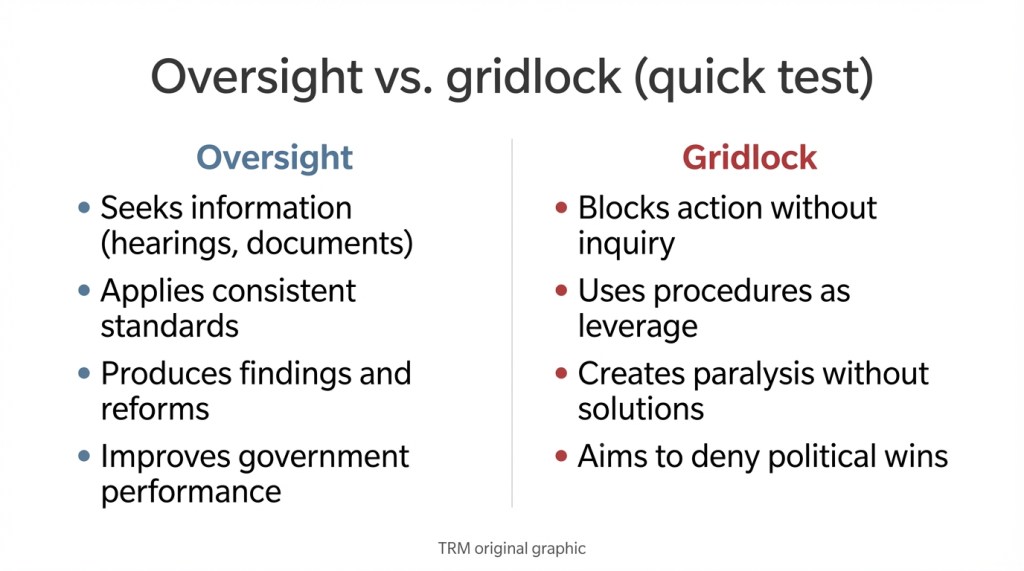
Oversight asks questions. Gridlock refuses answers.
Legitimate oversight seeks information through hearings, document requests, and testimony. The goal is accountability: determining whether laws were followed, whether programs work, whether officials are competent.
Gridlock doesn’t want information—it wants to prevent action. When Congress blocks nominees without even holding hearings, that’s not oversight, it’s obstruction.
Oversight applies consistent standards. Gridlock is partisan.
Genuine oversight investigates potential wrongdoing regardless of which party controls the executive branch. The same behavior should trigger the same scrutiny.
When Congress investigates minor issues under one president but ignores major scandals under another, that’s not oversight—it’s partisan theater. Benghazi hearings lasted longer than 9/11 investigations, not because Benghazi was objectively more important, but because it was politically useful.
Oversight results in action. Gridlock perpetuates paralysis.
After legitimate oversight, Congress acts: passes new legislation, reforms programs, confirms qualified nominees, or refers criminal conduct to prosecutors.
Gridlock leads nowhere. Hearings become PR stunts. Investigations never conclude. Nominations die without votes. The goal isn’t improvement—it’s perpetual conflict.
Unified vs. divided government
Oversight works better when government is divided. The opposition party has incentive and authority to investigate the executive branch. Without that tension, presidents face less scrutiny.
But divided government also enables gridlock. When one party controls the presidency and another controls Congress, obstruction becomes a viable strategy. Why allow the president to succeed if failure helps your party win the next election?
The challenge is maintaining legitimate oversight while preventing destructive gridlock—holding power accountable without sabotaging governance.
The filibuster: gridlock enabler
Senate filibuster rules require 60 votes to pass most legislation. In practice, this means any significant policy needs bipartisan support.
When parties cooperated, this promoted compromise. But as polarization increased, it became a gridlock machine. The minority party can block all legislation, confirmations, and reforms without offering alternatives.
This isn’t oversight—it’s veto power without accountability. The party blocking action doesn’t have to govern or propose solutions. They just say “no” until the next election.
Confirmation battles
The Constitution requires Senate approval for executive nominations. This enables oversight: rejecting unqualified nominees, extracting commitments on policy, demanding information.
But confirmation battles have become pure gridlock. Qualified nominees wait years for votes. Many nominations are blocked not due to competence concerns but to prevent the administration from functioning effectively.
Leaving positions vacant doesn’t improve government—it ensures agencies can’t do their jobs, which then becomes evidence of government dysfunction the opposition party can campaign against.
Shutdown politics
Congress must fund the government. This creates recurring leverage points where a determined minority can threaten shutdowns unless demands are met.
Budget disagreements are normal. But threatening shutdowns over unrelated policy demands—immigration, healthcare, social programs—isn’t oversight, it’s hostage-taking.
Shutdowns don’t hold the executive branch accountable. They harm federal employees, disrupt services, and damage the economy. They’re deliberate sabotage masquerading as principle.
Investigative theater vs. substantive inquiry
Legitimate congressional investigations follow evidence, call relevant witnesses, and produce reports with findings and recommendations.
Theatrical investigations:
- Invite witnesses known to provide sound bites, not information
- Hold hearings designed for TV clips, not fact-finding
- Leak selectively to friendly media
- Draw conclusions before hearing evidence
When a committee schedules more hearings on an issue after elections (when media attention increases) than before, that’s theater. The goal is political damage, not accountability.
What voters should demand
Support oversight, oppose gridlock:
- Investigations should be bipartisan, with minority party participation
- Qualified nominees deserve timely votes, not indefinite delays
- Budget fights should focus on spending levels, not unrelated policy hostages
- Hearings should produce information and recommendations, not just sound bites
Evaluate consistency:
- Does Congress investigate similar issues under different presidents?
- Are procedural objections applied equally to both parties?
- Do confirmation fights focus on qualifications or partisan advantage?
Demand results:
- After hearings, has policy improved?
- After investigations, have problems been addressed?
- After confirmation battles, are positions filled by competent people?
If the answer is always “no,” you’re witnessing gridlock, not oversight.
The institutional erosion
Gridlock normalized becomes institutional norm. When obstruction works politically, both parties adopt it. Standards collapse. Confirmations that once were routine become battles. Legislation that once passed with broad support dies in committee.
This erosion is cumulative and difficult to reverse. Each escalation by one party justifies retaliation by the other. Eventually, government stops functioning not because of policy disagreements but because obstruction is the default strategy.
Oversight holds power accountable and makes government better. Gridlock makes government worse as a political strategy. The first is democracy functioning. The second is democracy failing.
Knowing the difference isn’t about partisan allegiance—it’s about recognizing when Congress is doing its job versus when it’s deliberately sabotaging governance for electoral advantage. That distinction matters more than which party currently benefits from confusing the two.
Sources (timely examples)
- CRS: The 2025 (FY2026) Government Shutdown: Economic Effects (Jan 29, 2026). https://www.congress.gov/crs-product/R48832
- Politico: “Trump nominations package hits stumbling block in Senate” (Dec 4, 2025). https://www.politico.com/live-updates/2025/12/04/congress/senate-nominations-package-delay-00677016
 The Rational Moderate