
Capitalism: A reintroduction
“Capitalism” is one of the most overloaded words in American politics. It gets used as a synonym for freedom, greed, innovation, exploitation, or “whatever I already believe.”
This piece is simpler. It does three things:
- Defines capitalism as a system, not a slogan.
- Distinguishes capitalism from corporatism.
- Lays out reforms that preserve markets while reducing extraction.
Executive summary
The U.S. economy is capitalist in the basic sense: private ownership, markets, and profit incentives.
But many of the outcomes people blame on “capitalism” are better described as concentrated, politically engineered capitalism:
- Market power that suppresses competition.
- Rules written by incumbents.
- Finance and lobbying that distort incentives.
A serious defense of markets starts with admitting when markets are not functioning.
Start with a usable definition
Capitalism is an economic system where:
- People and firms can own productive assets.
- Prices, supply, and demand coordinate much of production and exchange.
- Profit and loss act as the scoreboard.
- The state sets and enforces rules that make exchange credible.
The definition matters because capitalism is not “no government.” Every real economy is mixed. The question is whether government intervention mostly does two things:
- Enforce common rules (property rights, contracts, anti-fraud, competition).
- Or grant advantages to specific incumbents (subsidies without discipline, loopholes, protective regulation, preferential procurement, bailouts).
When the second category dominates, you still have private ownership and markets. You also get extraction.
Capitalism is a system of rules, not an absence of rules
Markets are not self-executing. They require institutions.
A functional capitalist system usually includes:
- Property rights and contract enforcement so investment is worth making.
- Bankruptcy and reorganization so failure is survivable and resources can move.
- Competition policy so scale does not become permanent political power.
- Disclosure and anti-fraud rules so markets price reality.
- Labor standards and mobility so bargaining is not one-sided.
- Public goods investment where private returns understate social returns (basic research, infrastructure, broad education).
If you remove the rules, you do not get pure capitalism. You get rule by whoever can use coercion, monopoly, or insider advantage.
Capitalism, by the numbers (a snapshot)
The point is not to drown in stats. It is to anchor the conversation in reality.
- U.S. GDP: about $29T (2025).
- Unionization: private-sector union membership is in the single digits.
- Wealth concentration: top shares of wealth have risen materially over recent decades.
Charts

U.S. GDP (FRED)
What to notice: the economy is enormous and productive. The fight is over distribution, power, and access.
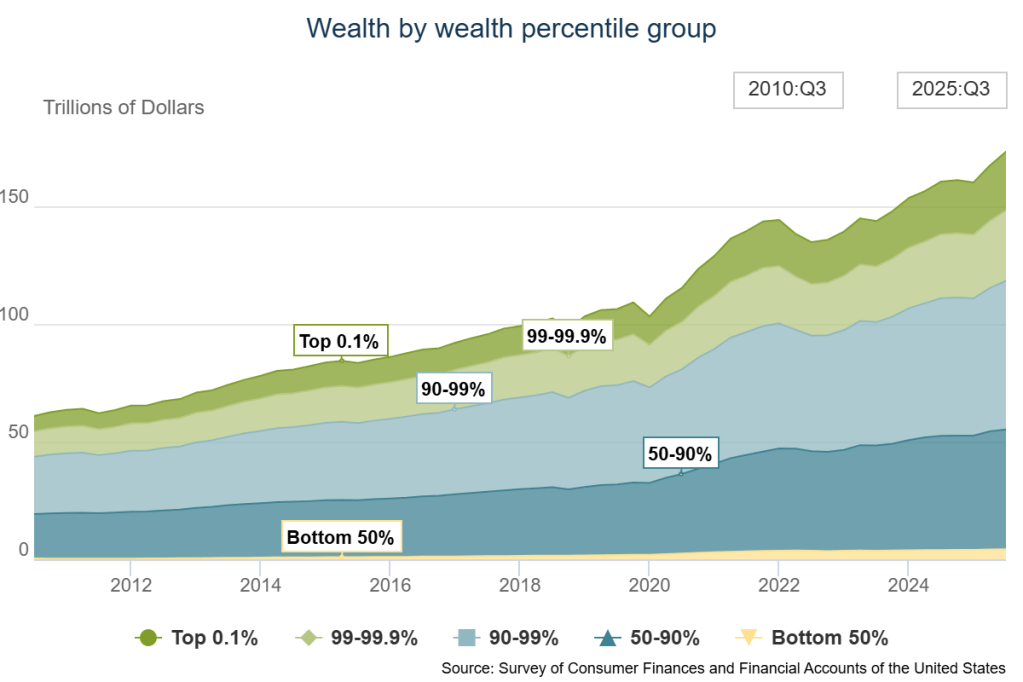
Source: https://www.federalreserve.gov/releases/z1/dataviz/dfa/distribute/table/
What to notice: the gap is not just income. Wealth concentration compounds across generations.
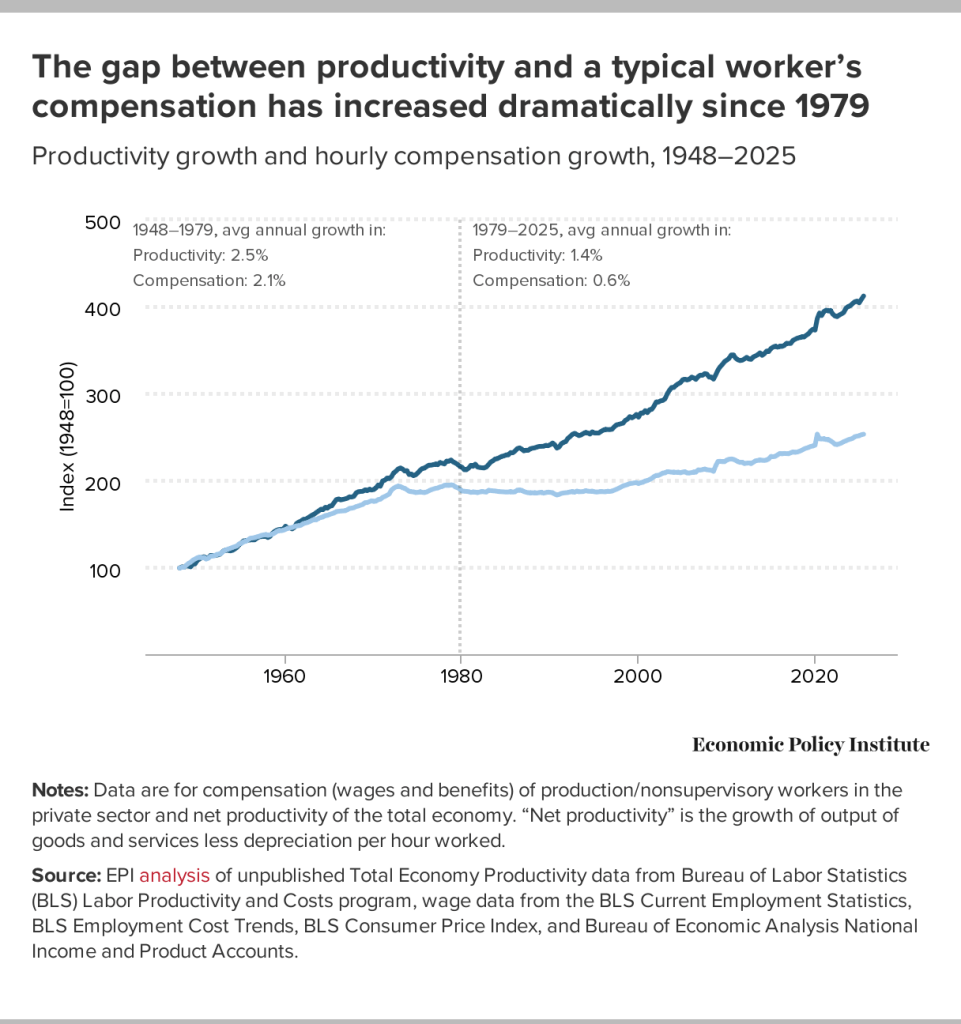
Source: https://www.epi.org/productivity-pay-gap/
What to notice: when productivity rises faster than pay for decades, the system’s legitimacy erodes.
The American variant: myth vs. reality
The U.S. story emphasizes entrepreneurship and innovation. Those are real.
The U.S. also has:
- large subsidies and public procurement
- complex regulation (sometimes necessary, sometimes captured)
- a lobbying ecosystem that small firms cannot match
- a financial sector with outsized influence on corporate incentives
In a healthy system, these features can coexist with competitive markets. In an unhealthy system, they blend into a structure where profits reflect political leverage as much as value creation.
Timely note: U.S. capitalism is getting more state-shaped (2025 to 2026)
- CBO’s 2026 to 2036 outlook highlights major policy changes in 2025, including tariffs and a large reconciliation act, that shift deficit and growth assumptions.
- Analysts across ideologies are arguing about whether the U.S. is drifting toward something closer to state capitalism or crony capitalism.
- The boundary between markets and the state is becoming a visible battleground.
Corporatism vs. capitalism (the distinction that matters)
Capitalism is supposed to reward firms that serve customers.
Corporatism rewards firms that can shape the rules.
Corporatism shows up when:
- dominant firms can buy competitors or block entry
- regulation becomes a moat rather than a referee
- profits are protected by political access
- losses are socialized while gains remain private
This is why “pro-market” and “pro-business” are not the same thing. Markets need churn. Incumbents often prefer stability.
What’s actually broken (three structural problems)
1) Market concentration and pricing power
Concentration is not always bad. Some industries have real economies of scale.
The problem is when concentration becomes a durable advantage that no longer reflects performance.
Common mechanisms:
- mergers that reduce meaningful competition
- network effects that lock in users and suppliers
- vertical integration that raises rivals’ costs
- switching costs and opaque pricing
What it can look like for households:
- prices that rise quickly when costs rise, but fall slowly when costs ease
- fewer choices, worse service, and less innovation over time
2) Short-termism and financial engineering
Profit incentives can be productive when they reward innovation and cost discipline.
They become corrosive when incentives reward financial maneuvers over long-term capability.
Common mechanisms:
- executive compensation tied to short-term stock price
- buybacks that become the default use of free cash flow
- underinvestment in training, resilience, and capacity
This does not mean buybacks are always wrong. It means governance and incentives matter.
3) Political capture
Capture is the bridge between economic power and political power.
Common mechanisms:
- lobbying that shapes tax and regulatory details
- revolving doors that blur public and private incentives
- procurement rules written to fit incumbents
- subsidies without performance conditions
Capture converts competitive markets into a semi-managed arena where the biggest players can preempt competition.
A practical reform menu
These are not revolutionary. They are maintenance.
The aim is to restore competitive pressure, reduce extraction, and make growth feel legitimate.
1) Stronger competition policy
- tougher merger scrutiny in already concentrated industries
- enforcement against exclusionary conduct that blocks entry
- rules that reduce switching costs and lock-in where feasible
2) Rules that limit capture
- transparency for lobbying and industry influence on rulemaking
- tighter revolving-door constraints for key regulatory roles
- procurement discipline that rewards performance and openness, not political access
3) Tax simplification and enforcement
- fewer carveouts and special credits that invite rent-seeking
- stronger enforcement that raises the cost of gamesmanship
- a clearer distinction between productive investment and pure avoidance
4) Pro-worker bargaining capacity and mobility
- labor standards that set a floor where markets underdeliver
- portable benefits and less friction to changing jobs
- non-compete and anti-poaching limits where they suppress wage competition
5) Public investment where markets underprovide
- basic research and commercialization pathways
- infrastructure and permitting reform to reduce bottlenecks
- education and training that supports mobility
A functioning capitalist system depends on broad participation, not only on headline GDP.
What this does and does not imply
This is not an argument against profit
Profit is a signal. It tells you a firm is converting scarce resources into something people value.
The problem is not profit. The problem is profit that comes primarily from restricting choice, shifting risk, or changing rules.
This is not an argument for central planning
Reform is often about making markets more market-like.
Competitive pressure is the most non-ideological accountability mechanism capitalism has.
This is not a claim that the U.S. is uniquely flawed
Many rich democracies wrestle with the same tensions: concentration, housing constraints, aging populations, and political polarization.
The U.S. difference is often scale and intensity, plus a political system that makes rule updates hard.
A simple way to spot the difference in real life
Ask two questions:
- Is the firm getting paid because it delivered value, or because customers and suppliers cannot realistically say no?
- If the firm failed, would the system let it fail, or would it be rescued because it is too connected or too large?
When the answers point toward “cannot say no” and “cannot fail,” you are closer to corporatism than capitalism.
Conclusion
Capitalism is not a moral identity. It is an operating system.
A healthy capitalist economy is one where competitive pressure is real, failure is survivable, rules are broadly applied, and opportunity is wide.
When those conditions erode, the economy still produces. Trust collapses.
Reintroducing capitalism means rebuilding the rule set so markets reward value creation more than leverage.
Sources
- BEA GDP: https://www.bea.gov/data/gdp/gross-domestic-product
- Federal Reserve Distributional Financial Accounts: https://www.federalreserve.gov/releases/z1/dataviz/dfa/distribute/table/
- EPI Productivity-Pay Gap: https://www.epi.org/productivity-pay-gap/
- OpenSecrets lobbying: https://www.opensecrets.org/federal-lobbying
- CBO: The Budget and Economic Outlook: 2026 to 2036 (Feb 2026). https://www.cbo.gov/publication/62105
- NPR: How Trump’s ‘crony capitalism’ has shaken up U.S. business (Dec 2025). https://www.npr.org/2025/12/22/nx-s1-5639916/trump-crony-capitalism-free-market
- Eurasia Group: Top Risks 2026. https://www.eurasiagroup.net/issues/top-risks-2026
- Eurasia Group: Risk 6, State capitalism with American characteristics (Jan 5, 2026). https://www.eurasiagroup.net/live-post/risk-6-state-capitalism-with-american-characteristics
Additional reading
- Housing Crisis: Supply, Demand, and Zoning Reform
- Why grocery prices feel higher even when inflation cools
- The difference between “jobs added” and “jobs people actually want”
- https://www.cbo.gov/publication/62105
- https://www.opensecrets.org/federal-lobbying
- https://www.epi.org/productivity-pay-gap/
 The Rational Moderate