
The U.S. corrections system is expensive, sprawling, and too often designed around punishment rather than rehabilitation. That is not just a moral problem. It is a performance problem.
This article does three things:
- Establishes scale, cost, and outcomes.
- Explains why a punitive-only model underperforms.
- Lays out reforms with evidence behind them.
Executive summary
A workable reform agenda is not “soft.” It is practical. It aims to reduce victimization and reduce the number of people who return to custody.
Core moves:
- Reduce unnecessary incarceration, especially where it does not improve public safety.
- Treat mental illness and addiction as health problems, including inside custody.
- Invest in education, training, and reentry supports that reduce predictable failure points.
- Align incentives so success means fewer returns to prison, not beds filled.
Corrections reform is often framed as a values debate. It is also a budgeting debate. Incarceration is among the most expensive tools the state uses, and it is frequently applied in ways that produce weak outcomes.
Corrections, by the numbers
- Incarceration scale: Roughly 2 million people behind bars; incarceration rate around 580 per 100,000.
- Prison population: About 1.25 million people in state and federal prisons at the end of 2023.
- Cost: Total corrections system costs on the order of $182B annually when including incarceration and broader system costs.
- Recidivism: Roughly 27% of people exiting prison in 2019 were reincarcerated within three years, down from 35% in 2008.
- Mental health: A meaningful share of incarcerated people have serious mental illness, and many do not receive adequate treatment.
Charts
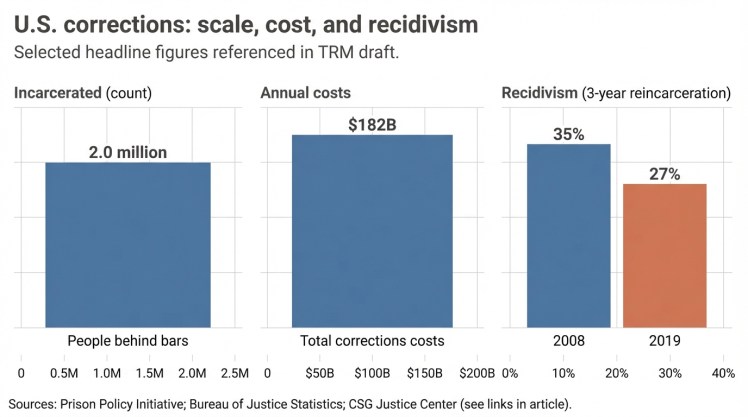
Sources: Prison Policy Initiative; Bureau of Justice Statistics; CSG Justice Center (see links in article).
Why the current system underperforms
A timely note (2025–2026)
Prison Policy Initiative’s 2026 reform agenda compiles near-term levers that are especially relevant for states, where most incarceration occurs.
1) Punishment without capacity for rehabilitation
Confinement can incapacitate people temporarily. It does not reliably change behavior by itself.
If the system is built primarily to warehouse people, it produces the outcome it is designed for: churn.
The most practical critique is not that punishment is never warranted. The critique is that prisons often do not provide enough education, treatment, and reentry planning to materially reduce risk once people return home.
RAND’s meta-analysis found correctional education is associated with lower recidivism and better employment outcomes after release. That is an operational finding: the system leaves performance gains on the table when programming is thin or uneven.
2) Mental illness and addiction treated as criminality
Prisons and jails have become de facto mental health facilities. That is not a compliment. It is an indictment of upstream failures.
When people cycle through custody without stable treatment, the system repeatedly pays for crisis management: disciplinary incidents, emergency care, and release without continuity of care.
The Treatment Advocacy Center’s summary highlights how many people with serious mental illness are in jails and prisons rather than hospitals.
Two policy implications follow:
- Diversion is not enough if the community system cannot absorb people.
- In-custody care matters. Many people will still be incarcerated. Their risk profile after release depends on what happens inside.
3) Incentives that reward beds filled, not lives rebuilt
In many jurisdictions, budgets, contracts, and politics are aligned to capacity and occupancy.
That creates a subtle but important failure mode: “success” becomes hard to define honestly.
A useful rule for reform design is to define success as fewer returns to custody and lower victimization, then align funding, facility policies, and reentry partnerships to that target.
What works (and why)
Evidence is strongest for interventions that do two things:
- build real skills and stability, and
- continue support across the transition from custody to community.
1) Education and vocational training
Correctional education is one of the strongest evidence-backed interventions in corrections.
RAND’s meta-analysis found people who participate in correctional education have lower odds of recidivating and better odds of post-release employment, though effects vary by program quality and local labor markets.
Why it works:
- Credentials and skills increase employability.
- Structured programming can improve routines and behavior inside.
- Earnings potential raises the opportunity cost of reoffending.
- http://www.rand.org/pubs/research_reports/RR266.html
2) Reentry support that targets predictable failure points
Reentry support works best when it reduces the common breakdowns immediately after release:
- no valid ID
- unstable housing
- gaps in medication and treatment
- missed probation appointments
- inability to legally work
The CSG Justice Center’s state-level analysis documents that reincarceration rates have declined since 2008, and it frames reentry investments as part of the mechanism behind that improvement.
Why it works:
- The first weeks after release are a high-risk window.
- Many returns to custody are technical violations and destabilization cascades, not new violent crimes.
3) Sentencing reform and alternatives where incarceration adds little safety
Reducing unnecessary incarceration frees resources for interventions that reduce crime.
A practical principle:
- Use incarceration for people who pose a high risk of serious harm.
- Use community-based sanctions and supervision for lower-risk cases, with swift responses to violations that do not automatically mean long prison returns.
This requires risk assessment discipline and transparent safeguards. It also requires political honesty: not every offense calls for prison, and prison is not a synonym for accountability.
4) Behavioral health treatment inside custody and after release
Substance use disorder and serious mental illness are overrepresented in incarcerated populations.
Treating these as purely disciplinary problems is expensive and ineffective.
What works better:
- evidence-based addiction treatment (including medication where appropriate)
- continuity of care at release (appointments, prescriptions, insurance enrollment)
- crisis stabilization options that reduce reliance on jail as a holding unit
This is not only humanitarian. It reduces incidents inside facilities and reduces risk after release.
5) Restorative justice (when used appropriately)
Restorative models can improve outcomes in specific contexts, especially for juveniles and certain non-violent offenses.
Used well, they can strengthen accountability by centering repair and community impact rather than symbolic punishment.
Used poorly, they can appear unserious or can be mismatched to victim needs.
What fails (or backfires)
Some popular approaches underperform or create predictable harms.
1) Programming that is too small, too late, or too disconnected
If education and treatment exist only as scarce “slots,” participation becomes arbitrary, and benefits do not scale.
If job training is not linked to real employer demand and reentry supports, it becomes a credential without a pathway.
2) Reentry without housing and healthcare continuity
Releasing someone with no housing plan and no continuity of medication is a recipe for relapse, violations, and emergency room cycling.
3) Supervision designed primarily to detect failure
Probation and parole can be structured to help people succeed or to quickly document noncompliance.
High surveillance without problem-solving capacity often increases technical violations without improving public safety.
A practical reform package (sequenced)
This package is designed to be politically legible and operationally realistic.
- Reduce unnecessary incarceration
- prioritize sentencing reforms for lower-risk, non-violent offenses
- expand diversion where community treatment capacity exists
- Expand treatment capacity
- evidence-based treatment inside facilities
- ensure continuity of care at release
- Scale education and job training
- treat programming as core operations, not a boutique add-on
- align credentials with local labor demand
- Invest in reentry
- housing supports, IDs, transportation, and employment navigation
- probation and parole designed around compliance support and proportional responses
- Align incentives to outcomes
- funding tied to reductions in reincarceration and improvements in employment and stability
- remove profit incentives that depend on occupancy
What it costs and what it buys
Corrections spending is a recurring expenditure. Many reforms are reallocations, not purely add-ons.
A basic budgeting frame:
- Prison beds are expensive.
- Emergency responses to untreated illness are expensive.
- Reincarceration churn is expensive.
Many effective interventions are cheaper than prison time, especially when they prevent returns to custody.
The political challenge is that savings often appear later, while implementation costs appear immediately.
Conclusion
Corrections reform is not a debate between accountability and compassion.
It is a debate between systems that repeatedly pay for failure and systems that invest in measurable reductions in harm.
A serious reform agenda focuses on outcomes:
- fewer victims
- fewer returns to custody
- safer facilities
- more stable reentry
This is how a corrections system earns legitimacy. It delivers public safety per dollar, not punishment theater.
Additional reading
- Prison Policy Initiative: Mass Incarceration: The Whole Pie 2025: https://www.prisonpolicy.org/reports/pie2025.html
- Prison Policy Initiative: Winnable criminal justice reforms in 2026: https://www.prisonpolicy.org/reports/winnable2026.html
- Bureau of Justice Statistics: Prisoners in 2023 – Statistical tables: https://bjs.ojp.gov/document/p23st.pdf
- RAND: Evaluating the Effectiveness of Correctional Education: http://www.rand.org/pubs/research_reports/RR266.html
- CSG Justice Center: 50 States, 1 Goal: https://csgjusticecenter.org/wp-content/uploads/2024/04/50-States-1-Goal_For-PDF_with508report.pdf
Sources
Bergseth & Bouffard (2007). Restorative justice programming for juvenile offenders: https://www.ojp.gov/ncjrs/virtual-library/abstracts/long-term-impact-restorative-justice-programming-juvenile
Prison Policy Initiative. Mass Incarceration: The Whole Pie 2025: https://www.prisonpolicy.org/reports/pie2025.html
Bureau of Justice Statistics. Prisoners in 2023 – Statistical Tables: https://bjs.ojp.gov/document/p23st.pdf
Prison Policy Initiative. United States Profile: https://www.prisonpolicy.org/profiles/US.html
CSG Justice Center. 50 States, 1 Goal: https://csgjusticecenter.org/wp-content/uploads/2024/04/50-States-1-Goal_For-PDF_with508report.pdf
Treatment Advocacy Center. More Mentally Ill Persons Are in Jails and Prisons Than Hospitals: http://www.treatmentadvocacycenter.org/storage/documents/final_jails_v_hospitals_study.pdf
RAND. Evaluating the Effectiveness of Correctional Education: http://www.rand.org/pubs/research_reports/RR266.html
 The Rational Moderate