
Series: Governance & Civic Health
Executive summary
Ranked-choice voting (RCV) does not magically make voters less angry.
What it can do is more practical: it changes the winning strategy. In a crowded field, a candidate who can unify a coalition has an advantage over a candidate who can only dominate a narrow base.
That is why RCV is often discussed as an anti-extremism reform. Not because it forces moderation, but because it reduces the payoff for the most polarizing approach.
RCV also has real tradeoffs. Counting is more complex, results can take longer, and implementation requires voter education.
A timely note: RCV is not just theory right now
RCV is in an active phase of U.S. debate.
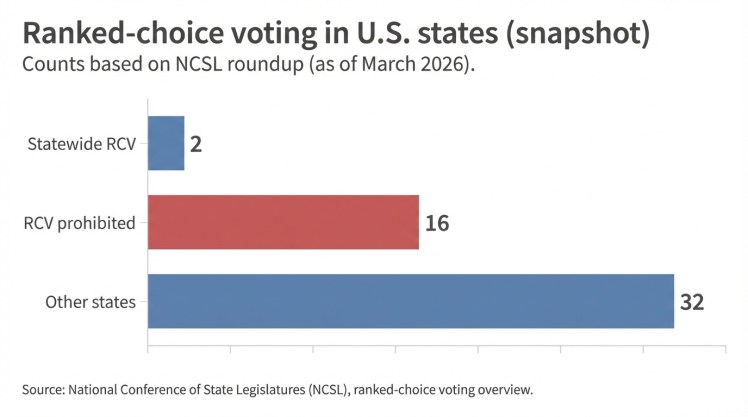
Source: National Conference of State Legislatures (NCSL), ranked-choice voting overview. As of March 2026.
https://www.congress.gov/bill/119th-congress/senate-bill/3425/text
Adoption is real (and contested). NCSL notes RCV is used statewide in Alaska and Maine, and that 16 states prohibit it (with many others neither clearly allowing nor banning it).
https://www.ncsl.org/elections-and-campaigns/ranked-choice-voting
The evidence base is growing. The American Bar Association’s 2025 literature review summarizes findings that RCV tends to improve representation and campaign quality, with mixed results in some areas and real implementation tradeoffs.
It is still a live national reform idea. Federal legislation titled the Ranked Choice Voting Act has been introduced in the 119th Congress.
1) Candidates need second-choice support
In a traditional election, each voter picks one candidate. Whoever gets the most votes wins, even if that is only 35% in a crowded race.
That creates a predictable incentive: energize a narrow base and win a fractured field.
RCV changes the game. Voters rank candidates (first, second, third). If nobody wins a majority, the last-place candidate is eliminated and those ballots transfer to the next-ranked choice.
The strategic effect is simple: the path to winning often requires being someone else’s acceptable option.

Example ranked-choice ballot (San Francisco)
What to notice: a voter can express a first choice without “wasting” the ballot. If the first choice is eliminated, the ballot can transfer to the next ranked candidate.
A quick example: plurality vs. RCV incentives
- Plurality: In a 4-way race, a candidate can win with ~35% by dominating a narrow base.
- RCV: Winning typically requires building a broader coalition, because second-choice support can decide the final rounds.
2) Negative campaigning becomes riskier
In a normal election, attacking an opponent can be strategically rational even if it alienates the opponent’s supporters.
Under RCV, alienating another candidate’s supporters has a direct cost: you may need their second-choice votes.
That does not eliminate negative ads. But it changes the calculus. Candidates have more incentive to contrast on substance and less incentive to burn bridges.
3) It reduces the “spoiler” problem
Plurality voting punishes honest preferences. If you vote for a third-party or outsider candidate, you risk helping elect the major-party candidate you like least.
RCV lets voters rank a first choice without throwing away influence. If the first choice loses, the vote transfers.
That has two benefits:
- Voters can support alternatives without fear.
- Candidates outside the two-party lane can compete without acting as accidental kingmakers.
4) Primaries get less dominated by the most intense voters
In many places, the primary is the real election.
Plurality primaries tend to reward candidates who can win a narrow slice of high-propensity voters.
RCV makes it harder to win by mobilizing only the most intense faction. Candidates need broader appeal inside the coalition.
One caution: depending on the ballot design and voter education, RCV can increase ballot exhaustion (ballots that do not transfer to a remaining candidate), which is a real representation tradeoff worth measuring.
What RCV doesn’t fix
RCV is not a cure for everything.
It does not eliminate:
- Geographic sorting (deep-red or deep-blue districts)
- Nationalized politics
- Money in campaigns
- Media incentives
RCV improves the incentives at the margin. That is often how governance gets better: not through utopia, but through fewer perverse rewards. That is often how governance gets better: not through utopia, but through fewer perverse rewards.
Where RCV is used (and where it isn’t)
FairVote maintains a running list of jurisdictions that use RCV.
NCSL’s roundup is also useful for the legal landscape.
https://www.ncsl.org/elections-and-campaigns/ranked-choice-voting
Sources
- NCSL overview (implementation and statutory context): https://www.ncsl.org/elections-and-campaigns/ranked-choice-voting
- American Bar Association literature review (updated for 2025): https://www.americanbar.org/groups/public_interest/election_law/american-democracy/our-work/what-we-know-about-ranked-choice-voting-2025/
- FairVote jurisdiction list and context on where RCV is used: https://fairvote.org/where-is-ranked-choice-voting-used/
- Ranked Choice Voting Act text (119th Congress): https://www.congress.gov/bill/119th-congress/senate-bill/3425/text
 The Rational Moderate