
Why grocery prices feel higher even when inflation cools
When inflation drops from 9% to 3%, economists celebrate. At the grocery store, most people feel something else: sticker shock that never really went away.
A key point gets lost in the headlines. Lower inflation is not the same thing as lower prices. It is the difference between a punch and a slow squeeze.
A second point gets lost too: even when the overall inflation rate cools, food can behave differently. Recent BLS CPI reporting shows food inflation running above the all-items pace, with food still up year over year in the latest release.https://www.bls.gov/news.release/cpi.nr0.htm
1) Inflation measures the rate of change, not the price level
Inflation is velocity, not altitude. When inflation “cools” from 9% to 3%, prices are not falling. They are rising more slowly.
That is why “inflation is under control” can be statistically true and emotionally tone-deaf at the same time. The 2021–2023 price jump becomes a new baseline unless we see deflation.
2) Grocery prices are uniquely visible (and that matters)
We do not buy cars every week. We do not comparison-shop appliances every month. But groceries show up in our lives constantly.
That frequency creates a simple reality: people remember last year’s shelf tag. They also notice when the cart looks the same, but the total does not.
3) Wages have not fully closed the gap for many households
Wages can rise in aggregate and still fail to catch up for millions of individuals. Some households saw pay growth that beat inflation. Many did not.
To make this concrete, the cleanest public data comparisons are:
- CPI “Food at home” for grocery inflation
- A wage series like the Employment Cost Index
Charts

CPI: Food at home (FRED)
What to notice: grocery prices surged and then leveled off at a higher plateau. The plateau still hurts.

Employment Cost Index: Wages and salaries (FRED)
What to notice: wages trend upward, but the question is whether they outpace the price level jump for the median household.
Chart sources:
- CPI Food at Home series (BLS via FRED). [https://fred.stlouisfed.org/series/CUSR0000SAF11]
- Employment Cost Index (wages and salaries), BLS via FRED. [https://fred.stlouisfed.org/tags/series?t=employment cost index]
- BLS average prices for common items: [https://www.bls.gov/charts/consumer-price-index/consumer-price-index-average-price-data.htm]
- USDA ERS interactive (Tableau):
- Interactive view: A closer look at retail-food spending and its price environment
- Static preview image:
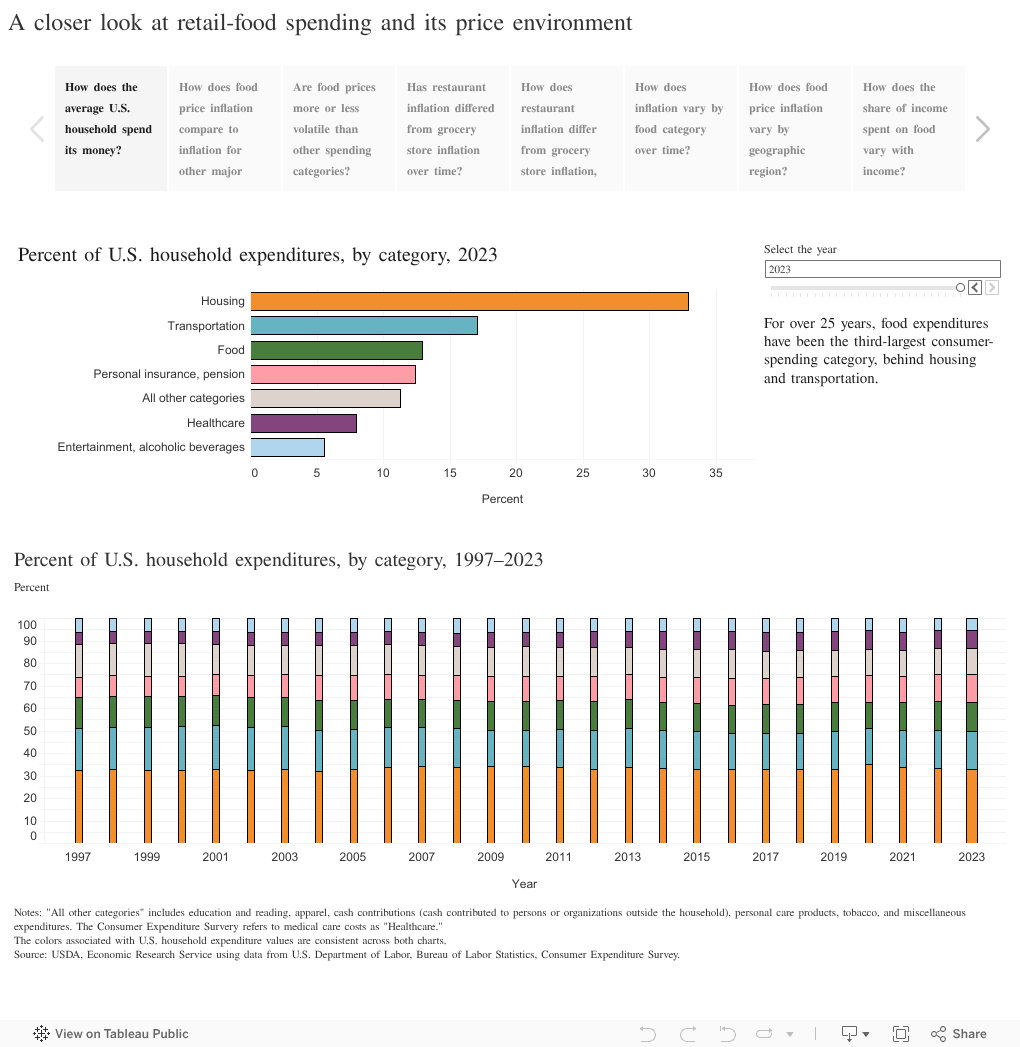 USDA ERS Food Price Environment (Tableau preview)
4) Shrinkflation is inflation in disguise
That bag of chips that used to contain 16 ounces now contains 13. The ice cream container shrank from half a gallon to 1.5 quarts. The sticker price may not move much, but the unit price does.
It is also worth being precise here. Official statistics are not “ignoring” downsizing. Agencies attempt to adjust for quantity changes. The real issue is that consumers experience the unit-price squeeze directly, and it can feel like prices are rising even when the shelf tag looks stable.
One practical habit helps here: when two packages look similar, check the unit price on the shelf label (price per ounce, pound, or count).
For a clear definition (and examples) of shrinkflation/product downsizing, see GAO’s explainer.https://www.gao.gov/blog/what-shrinkflation-and-how-has-it-affected-grocery-store-items-recently
Consumers do not experience “hedonic adjustments.” They experience running out of orange juice faster than they used to.
5) The comparison point is not last month. It is “normal.”
Economists often compare this month to last month. Consumers compare this month to the last period that felt stable, which for many households means pre-pandemic prices.
That is not irrational. It is a perfectly human way to measure the cost of a life.
What would real relief look like?
There are only a few paths that actually move the needle.
Recent data to watch
USDA’s Food Price Outlook provides near-term forecasts (updated monthly). It is useful because it separates “food at home” from “food away from home,” which helps explain why grocery relief can be uneven.http://www.ers.usda.gov/data-products/food-price-outlook/summary-findings
- Wage growth outpacing inflation for several years. This is the healthiest route, but it takes time.
- Prices falling (deflation). This is rare, and usually arrives with broader economic pain.
- Other major costs easing while wages catch up. If housing, insurance, and healthcare keep rising, grocery “relief” never feels like relief.
The hard truth is that the 2021–2023 jump is largely baked in. The question for 2026 is whether incomes regain the ground that was lost.
Sources
- Bureau of Labor Statistics, CPI overview: https://www.bls.gov/cpi/
- BLS CPI latest release (context on overall vs. food inflation): https://www.bls.gov/news.release/cpi.nr0.htm
- CPI “Food at home” series (CUSR0000SAF11) via FRED: https://fred.stlouisfed.org/series/CUSR0000SAF11
- BLS Employment Cost Index (ECI): https://www.bls.gov/eci/
- GAO explainer on shrinkflation/product downsizing: https://www.gao.gov/blog/what-shrinkflation-and-how-has-it-affected-grocery-store-items-recently
- USDA ERS Food Price Outlook (monthly): http://www.ers.usda.gov/data-products/food-price-outlook/summary-findings
Next reading
- Housing: supply constraints and zoning reform
- Student debt: why it blocks mobility
- Childcare: why the market fails both parents and providers
Discover more from The Rational Moderate
Subscribe to get the latest posts sent to your email.

3 thoughts on “Why Grocery Prices Still Feel High Even as Inflation Cools”