
Non-Defense Discretionary spending ranks as the third largest category in the federal budget with $600.3 billion in 2016. Spending in this category can be broken out into seven distinct groups, which can be seen in the chart (from 2015) below30.

Let’s take a closer look at each of these groups.
Health Care and Health Research
Funds in this group go primarily to hospital and medical care for veterans, research for things like cancer treatments and vaccines, funding the Indian Health Service, Centers for Disease Control and Prevention, and the Food and Drug Administration. Finally, it funds Medicare administrative costs30.
Transportation and Economic Development
Funds in this group go to air, group, and water transportation programs like the National Highway System, air traffic control and aviation safety, the Coast Guard, and transportation security30. On the economic side, funding goes toward community development activities, disaster insurance, prevention, and relief, and agriculture programs30.
Education and Training
A majority of the funds from this group go to K-12 education, aiding school districts in the education of students with disabilities and low-income students, and higher education programs like Pell Grants30. Other funds from this group go toward “early education, employment, and other services for children and families, seniors, and people with disabilities”30. Finally, this group is responsible for funding education and training for veterans’ employment, training, and rehab programs as well as public education and cultural programs, public broadcasting, public libraries, and museums30.
Economic Security
Funds from the Economic Security group provide for programs that help households meet basic needs like housing, energy, child care, and food costs30.
Science, Environment, and Energy
About half of the spending in this group goes toward resource conservation and management of natural resources, like national parks and the Environmental Protection Agency.
NASA’s budget is funded from this group as is the National Science Foundation and the Department of Energy. Spending for water resources infrastructure falls into this group30.
Law Enforcement and Governance
Funding for law enforcement, criminal justice, and correctional facilities are paid for by this group. This includes the FBI, border control, IRS, Congress, federal courts, the Government Accountability Office, and other basic government operations30.
Diplomacy and International Affairs
This group is responsible for providing international development and humanitarian assistance funds. This includes disaster assistance, the Peace Corps, global HIV and AIDS initiatives, and support to international agencies like the World Health Organization30. Responsibility for the maintenance and protection of U.S. embassies and consulates also falls under this group.
Conclusion
Although NDD spending is far-reaching, when compared to U.S. GDP, the rate of spending has stayed fairly consistent and low30.
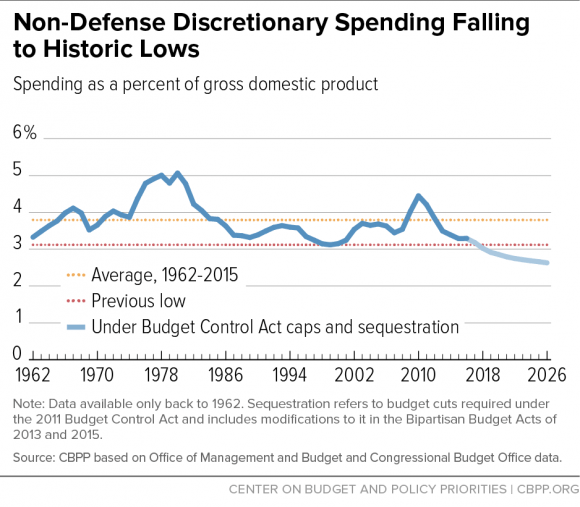
If anything, I am of the belief that we should be spending more on this category in an effort to support rural development, space exploration, public education, and international humanitarian efforts. At this time, I do not see any need to cut spending from this category.
Next on the list: Defense
References
30 Center on Budget and Policy Priorities. 2016. Policy Basics: Non-Defense Discretionary Programs.
Discover more from The Rational Moderate
Subscribe to get the latest posts sent to your email.

3 thoughts on “Balancing the Federal Budget: Non-Defense”